
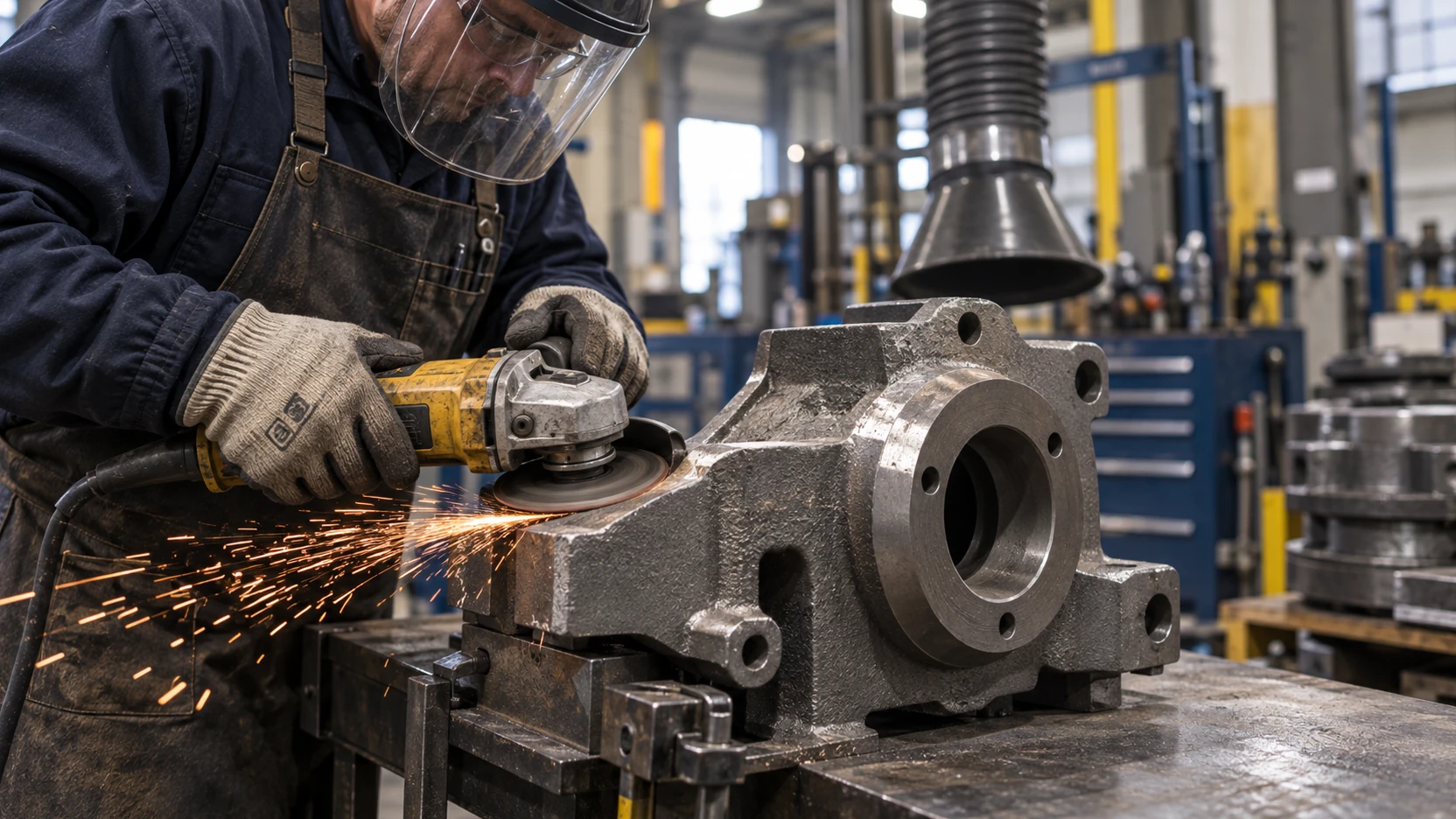
A finishing request needs to describe the condition a part arrives in and the condition it must leave in. “Clean up the casting” may mean removing a gate, blending a parting line, or breaking a sharp edge. Those operations have different limits, handling needs, and checks.
For a useful quote, identify the material to be removed, the surfaces to protect, and how the finished result will be accepted.
Define the work on the part
Grinding removes material from a selected area. Sanding can refine a surface or blend marks. Deburring removes unwanted burrs and sharp edges. The appropriate tools and sequence depend on the material, geometry, and specified result.
On a casting, identify gates, risers, and parting lines that need attention. On a machined component, identify the edges or features affected by burrs. Marked photographs can help explain the issue, but they should accompany the controlling drawing or acceptance criteria when dimensions matter.
Identify critical surfaces and limits
Tell the provider which surfaces locate, seal, mate, or carry a required finish. Include dimensional limits, edge requirements, and any areas where material removal is restricted. A smooth appearance alone does not establish that a dimension or surface requirement has been met.
- Which drawing revision applies?
- Where must material be removed, and where must it remain?
- Is acceptance based on dimensions, a surface requirement, a boundary sample, or a combination?
- Does the part need a check before and after finishing?
Confirm capability for the actual part. Casting cleanup should not be assumed to include every type of precision surface, cylindrical, or centerless grinding. Equipment, fixturing, and inspection requirements need to be agreed for the work being quoted.
Make repeat work easier to control
For a recurring program, explain the release quantity, expected frequency, and variation in the incoming condition. If some castings need substantially more cleanup than others, that affects both processing and the assessment of parts that may not be recoverable.
An approved sample or initial batch can help establish the expected result. Agree how questions will be handled, who approves additional work, and how parts outside the agreed scope will be identified. Do not let an uncertain salvage decision turn into unapproved material removal.
Include handling and the next operation
Specify packaging that protects the finished areas. Explain whether parts go to inspection, blasting, coating, storage, or assembly next. That information helps establish an appropriate handoff without treating a finishing operation as a guarantee of performance in every later process.
WGS offers casting finishing, grinding, sanding, and deburring. Its published certificate lists the certified scope and locations. For a quote, describe the part's size and material, the required work, volume, and timing. Mention available drawings so their transfer can be arranged.